AI medical scribe: the note is ready when the patient leaves, every sentence traceable
Notat first extracts the clinical facts from the conversation, then writes the note only from those facts. Each sentence links back to what was said, so you check the draft instead of retyping it.
“I stopped finishing charts at nine in the evening. The note is there when the patient leaves, and I just check it over.” Dr. Marta Estrada, Family medicine, Barcelona
Processed and stored in the EEA
Audio never stored
Encrypted in transit and at rest
Notes auto-deleted after 24 h
Never used to train models
2,000+ clinicians
- Security details →
See it sync, live
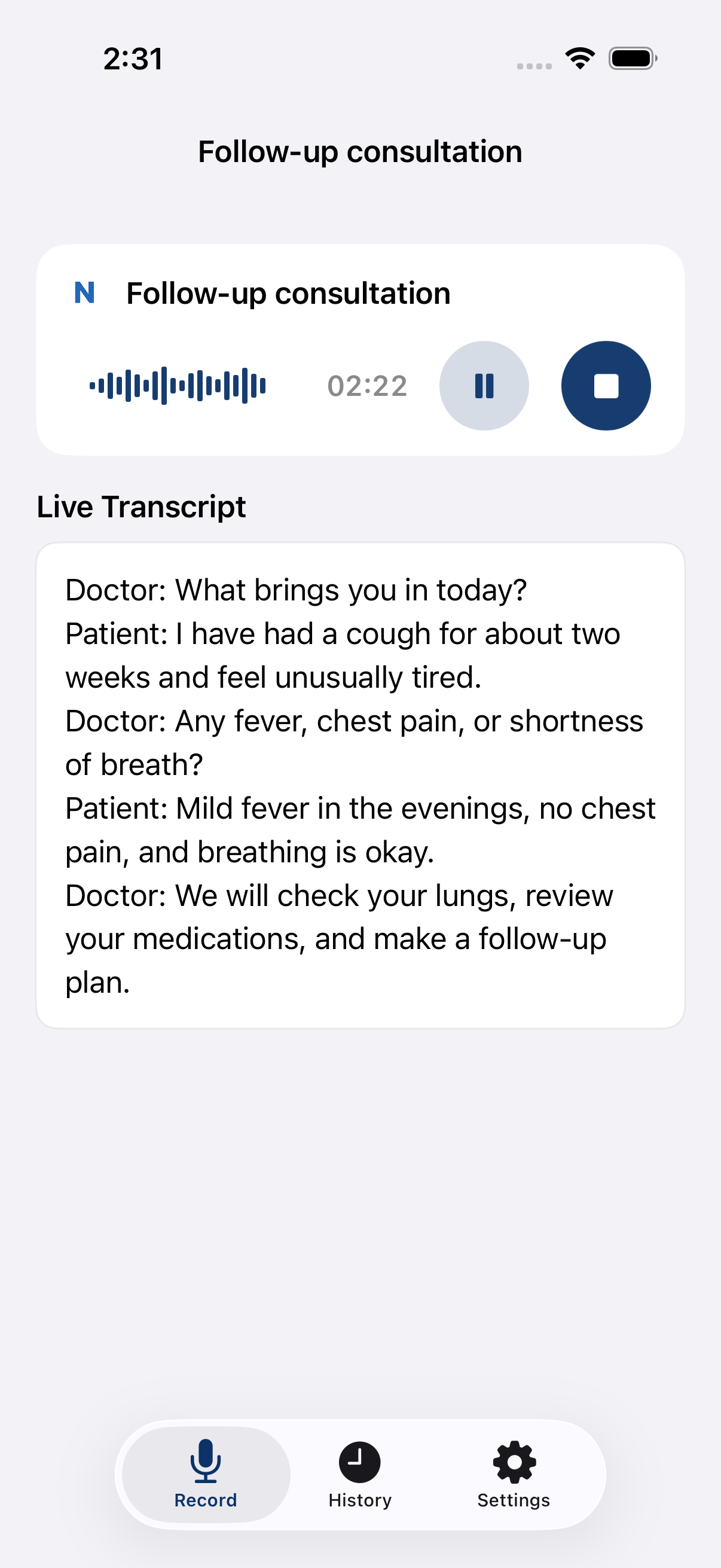
Record on your phone or your desktop — Notat keeps every device in sync in real time. Every note, code suggestion, and follow-up plan is generated live from FactsContext™, the structured clinical facts behind everything Notat writes.
See how FactsContext™ worksLive extraction active.
Why clinicians choose Notat
FactsContext™ separates understanding from writing. The four-step workflow gives you a clear path from what was said to what was documented — and keeps the clinician in control.
The facts are yours
Notat shows you the raw extracted medical facts from every encounter — not just the polished note. Inspect them, verify the note against them, or reuse them however you please.
Every sentence is traceable
Because documentation is generated from structured facts, every statement in the note traces back to something that actually happened in the encounter.
Nothing invented
Transcript-direct AI fills gaps with plausible-sounding text. FactsContext™ is designed to reduce unsupported statements by only writing from verified clinical facts.
Notes you can trust
Every drafted note is tied to the evidence in the transcript. Nothing is invented, and you review before it counts.
Less after-hours charting
Clinicians on Notat spend their evenings somewhere other than the EHR. The note is mostly done when the visit ends.
Coding that is reviewable
ICD-10 suggestions come with the clinical reasoning behind them, so a clinician or coder can confirm in seconds rather than dig.
Works where you work
Drafts push into the EHR and systems your clinic already uses. Notat fits the workflow instead of forcing a new one.
Four steps to the finished note
1
Start the visit
Open Notat on the web or the iOS app and begin. No templates to configure, no voice commands to memorize.
2
Have the conversation
Talk with your patient as usual. Notat transcribes and extracts the clinically relevant facts in real time.
3
Review the note
A structured draft is ready when you stop. Read it, edit it, and check the suggested codes against the evidence.
4
Send it on
Push the finished note to your EHR or export it. The visit is documented before the next one starts.
How clinicians use Notat
During the visit. Notat listens in the background. Keep your attention on the patient instead of a screen, and the conversation is captured as it happens.
After the visit. A structured note is ready in seconds, organized the way your specialty expects. Edit anything, then sign off and move on.
Across the day. Stop carrying documentation home. Visits that used to mean an hour of typing now close before the next patient walks in.
Across languages. Patients speak in their own language and the note comes out in yours. Notat handles 14 languages without losing clinical detail.
How Notat compares
Honest, dated comparisons — every competitor claim carries an "as of" date and a public source where one exists.
Notat vs Abridge
Abridge is a generative AI documentation company and Epic's first "Pal" partner, with a peer-reviewed validation study, revenue-cycle and prior-authorization features, and expansion into inpatient settings. Its public footprint is strongest in US, Epic-installed health systems.
Notat vs Heidi
Heidi Health is an ambient AI scribe with a free individual tier and paid Clinician/Practice plans, publishing separate HIPAA and GDPR compliance pages plus a Trust Center. Its public footprint spans AU/NZ, Canada, the UK, and the US. We have not independently verified its language count or SOC2/ISO27001 status; those cells stay "Not publicly documented".
Notat vs Freed
Freed is an ambient AI scribe built for individual clinicians, priced per seat with a 7-day free trial, HIPAA-compliant and SOC 2 Type 1 & 2 certified, and publicly documented as supporting 14 languages. It does not publish an Epic-specific integration story.
Common questions
What is an AI medical scribe?
An AI medical scribe listens to the patient consultation and drafts a structured clinical note from it, so the clinician reviews a finished draft instead of typing one from scratch. Notat ties every part of the draft to the evidence in the transcript.
What is the difference between an AI scribe, dictation, and transcription?
Medical transcription turns recorded speech into text, and medical dictation turns a clinician's spoken instructions into a note. An ambient AI medical scribe listens to the consultation and drafts a structured clinical note from the visit for the clinician to review and sign.
Is the AI note ready to sign without editing?
No. The note is a draft for the clinician to review and edit. Notat never invents content, and every suggested code is checked against the documented encounter before it is used.
Does it work in my language?
Notat supports 14 languages. Patients can speak in their own language and the note is drafted in the language the clinician works in, without losing clinical detail.
Does it suggest ICD-10 codes?
Yes. Notat suggests ICD-10 codes supported by the documented facts, each with its clinical reasoning, so a clinician or coder can confirm quickly rather than search from scratch.
How much does Notat cost?
The Free plan includes 10 notes per month. Paid plans for higher volume and clinic features are listed on the pricing page.
How is patient data protected?
Notat processes and stores data in the European Economic Area under GDPR. Audio is handled in short chunks and each chunk is deleted after processing, so a full recording is never stored. Data is encrypted in transit and at rest, notes are deleted automatically after 24 hours, and clinical inputs are not used to train models. For a data processing agreement, contact [email protected].
Where is my data stored?
All processing and storage take place within the European Economic Area (EEA). Your data does not leave the EEA.
How do I get the note into my EHR?
You can copy or export the finished note into any EHR. Notat does not replace your record system; it gives you a note ready for your review to put into it. Direct EHR connections are enabled for selected accounts, so ask us on the contact page if you need one.
How accurate is the note?
Notat extracts the clinical facts from the conversation first and writes the note only from those facts. Each sentence can be traced back to what was said, and you review and edit the note before signing. As with any AI draft, your review is the final safeguard.
What AI medical scribe software does
An AI medical scribe turns a clinician–patient conversation into a draft clinical note. An ambient scribe does this in the background, without requiring the clinician to dictate or type during the visit.
Medical transcription
Turns recorded speech or dictation into text.
Medical dictation
Turns the clinician’s spoken instructions into a structured note.
Ambient AI scribe
Listens to the consultation and drafts the note from the visit.
Notat’s workflow
Extracts the clinical facts first, writes the note from those facts, and shows the context for clinician review before signing.
Choosing and trusting an AI medical scribe
- Ambient AI scribe
Ambient AI scribe that listens in the background of the visit and writes the note afterward. No voice commands, no clicking through templates.
- AI clinical notes
AI clinical notes drafted from the consultation in seconds. Structured, editable, and tied to the evidence in the transcript.
- AI medical dictation
AI medical dictation that turns speech into a structured note. Speak naturally during the visit and review a finished draft afterward.
- AI SOAP note generator
AI SOAP note generator that organizes the visit into Subjective, Objective, Assessment, and Plan, ready for the clinician to review.
- AI medical transcription
AI medical transcription with clinical accuracy. Speaker-aware transcripts of the consultation that feed directly into the note.
- AI medical documentation
AI medical documentation that captures the encounter, drafts the note, and prepares reviewable records for the systems your clinic already uses.
- Best AI medical scribe
How to choose the best AI medical scribe in 2026: hallucination safeguards, languages, compliance, and workflow fit — plus honest, dated comparisons of the leading options.
- AI medical scribe comparison
Side-by-side AI medical scribe comparison: Notat vs Abridge, Dragon Copilot, Suki, Nabla, Ambience, Heidi, Freed, DeepScribe, Commure, and Sully — dated, sourced, and fair.
- Multilingual AI medical scribe
A multilingual AI medical scribe for real clinics: spoken capture in 90+ languages, cross-language visits, documentation in the record’s language, and product translation in 15 languages.
- HIPAA compliant AI scribe
A HIPAA compliant AI medical scribe with BAA available, zero audio retention, and no training on patient data — plus documentation you can verify against extracted clinical facts.
- GDPR compliant AI scribe
A GDPR-native AI medical scribe with EU hosting, zero audio retention, no training on patient data, spoken capture in 90+ languages, and product translation in 15 languages.
- AI scribe hallucinations — and how Notat prevents them
Why AI medical scribes hallucinate, what it means for patient safety, and how Notat’s patent-pending FactsContext™ engine combats hallucination by generating notes only from verified clinical facts.
- AI medical scribe cost — what actually drives the price
What an AI medical scribe costs in 2026: pricing models, what drives the price, and how to compare plans honestly — including Notat’s free tier.
- Best AI medical scribe app — how to choose in 2026
How to choose the best AI medical scribe app in 2026: native mobile workflows, hallucination safeguards, languages, compliance, and honest, dated comparisons.
- Free AI medical scribe — what you actually get
A free AI medical scribe: capture a real consultation, review a structured note, and verify the facts — before you pay.
- AI DAP note generator for behavioral health clinicians
See how Notat turns a behavioral-health conversation into reviewable FactsContext™ facts and a DAP progress-note draft for the clinician to edit and sign.
- AI BIRP note generator for therapy sessions
See a BIRP note workflow from therapy-session transcript to reviewed FactsContext™ facts and a clinician-editable behavior, intervention, response, and plan draft.
- AI progress note generator for reviewable clinical drafts
Turn a follow-up conversation into reviewed FactsContext™ facts and a clinician-editable progress-note draft, without competing with a general clinical-notes workflow.
- Notat AI vs Notta AI: not the same product
Notat AI and Notta AI are unrelated products from different companies. Notat is a clinical documentation scribe for doctors and other clinicians; Notta is a general meeting-transcription tool. Here is how to tell them apart.
Try the visit without the paperwork
Notat drafts the note from the conversation so you can spend the visit with your patient, not your keyboard. Start a free trial in about ten minutes.