Best AI medical scribe
How to choose the best AI medical scribe in 2026: hallucination safeguards, languages, compliance, and workflow fit — plus honest, dated comparisons of the leading options.
What actually separates AI medical scribes
Most AI scribes transcribe the visit and ask a language model to write a note from the transcript. The differences that matter are architectural: does the system verify what it writes, can you see why a sentence appeared, does it handle your language and your compliance regime, and does it fit how your practice actually works?
Judge the architecture, not the demo
Every scribe looks impressive in a two-minute demo. The question is what happens on the messy visits: interruptions, multiple speakers, mixed languages, medication changes discussed twice. Notat’s patent-pending FactsContext™ engine extracts structured clinical facts first and generates the note from those facts — and shows you the facts, so you can verify any sentence against its source instead of re-listening.
The checklist that matters
Hallucination safeguards by design, not just review prompts. Spoken capture in 90+ languages, plus product translation in 15 languages: English, Norwegian, Danish, Swedish, Finnish, Estonian, Dutch, German, Spanish, Italian, French, Arabic, Polish, Portuguese, and Hindi. GDPR-native EU hosting or HIPAA with BAA, depending on where you practice. Zero audio retention. Coding suggestions with evidence. Native apps where you work. A trial you can start today without procurement.
Compare the leading options honestly
We keep dated, sourced comparisons of Notat against Abridge, Dragon Copilot, Suki, Nabla, Ambience, Heidi, Freed, DeepScribe, Commure, and Sully — with anything we cannot verify marked "Not publicly documented" instead of guessed.
See it sync, live
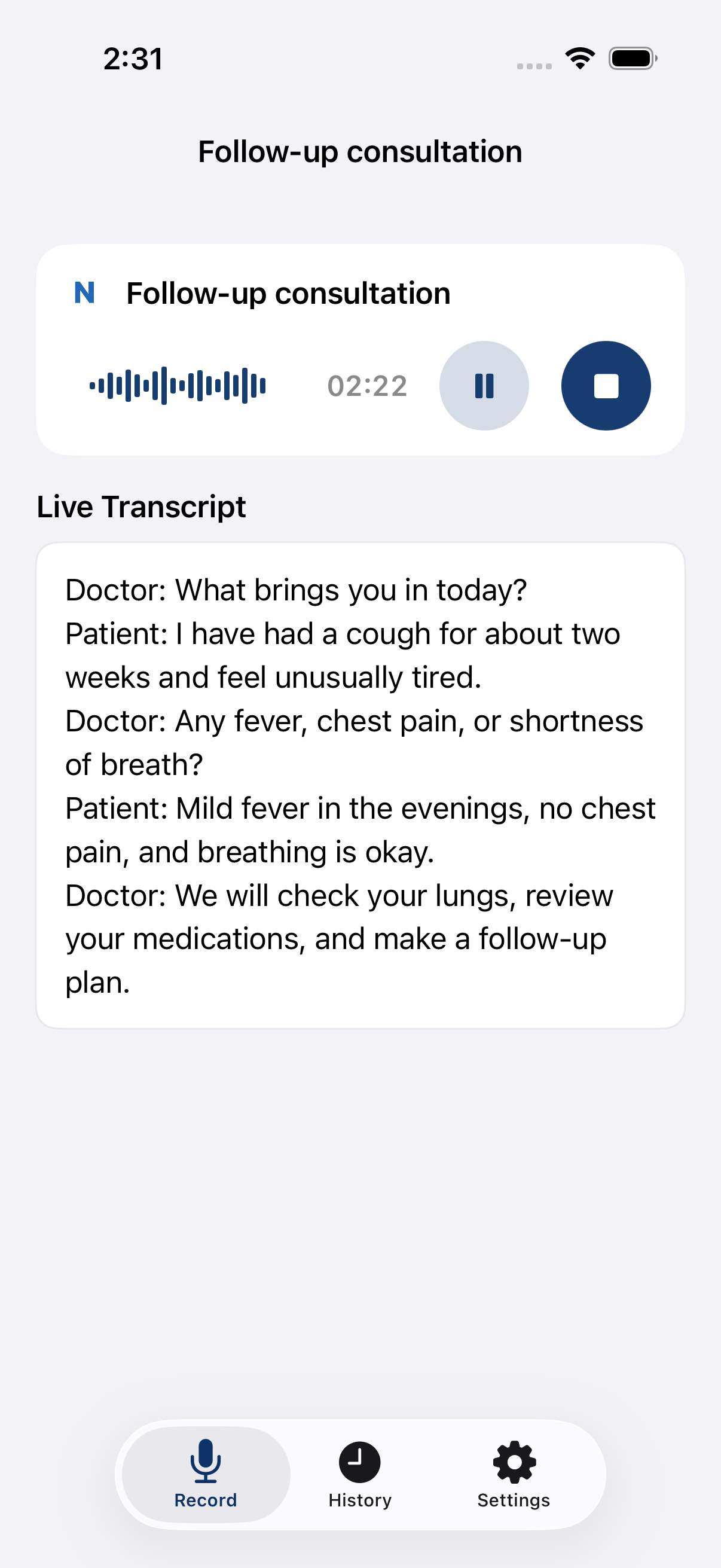
Record on your phone or your desktop — Notat keeps every device in sync in real time. Every note, code suggestion, and follow-up plan is generated live from FactsContext™, the structured clinical facts behind everything Notat writes.
See how FactsContext™ worksLive extraction active.
How the main AI medical scribes compare
Based on each vendor’s public documentation, verified as of 2026-08-11. Where a vendor doesn’t document something, we say so rather than guess.
Notat | Heidi | Freed | Abridge | Dragon Copilot | Nabla | |
|---|---|---|---|---|---|---|
Ambient visit documentation | Ambient scribe with a free tier | Individual-clinician ambient scribe | Generative AI visit documentation | Ambient AI + Dragon Medical One dictation heritage | Ambient scribe with strong UX | |
Medical coding suggestions | Not publicly documented | ICD-10 codes added to notes; CPT suggestions in beta on higher tiers | Revenue-cycle and prior-auth features | Not publicly documented | Not publicly documented | |
Native iPhone, iPad & Mac apps | iPhone app on the App Store | iPhone, iPad and Mac app | iPhone app for recording; notes are edited and sent to Epic on the web | Microsoft Dragon Copilot iPhone app | Android app on Google Play; iOS app not verified | |
Multilingual & cross-language documentation | 110+ languages per its App Store listing | Publicly documented support for 14 languages, vs. Notat’s 90+ | Limited European clinical context and languages per public positioning | Not publicly documented | Not publicly documented | |
GDPR-native / EU hosting | Publishes a GDPR compliance page; EU hosting posture not independently verified | Not publicly documented | Not publicly documented | Not publicly documented | GDPR compliant; non-US data hosted in the EU, speech-to-text processed in US regions | |
HIPAA / BAA | Publishes a HIPAA compliance page | HIPAA-compliant, SOC 2 Type 1 & 2 certified, HITECH-compliant; does not store patient recordings | Not publicly documented | Not publicly documented | Not publicly documented | |
Epic / EHR support | Not publicly documented | Not publicly documented | Epic's first "Pal" partner; deep Epic integration | Deep Epic integration; Microsoft ecosystem | Primarily standalone; "Nabla Connect" for EHR embedding | |
Self-serve free trial | Free plan plus a 14-day trial on paid Clinician/Practice tiers | 7-day free trial, no credit card required | Not publicly documented | Not publicly documented | Not publicly documented |
How to judge a scribe in a free trial
- Record a real (consented) visit in the language you actually consult in, then check every fact in the note against what was said.
- Try a messy visit: interruptions, two problems, a family member talking. That is where scribes invent or drop details.
- Check whether you can see what the note was written from, not just the finished text.
- Time the whole loop: from the end of the visit to a signed note in your record system.
- Ask where audio and notes are stored, for how long, and whether a data processing agreement or BAA is available.
Frequently asked questions
Which AI medical scribe is the most accurate?
Accuracy claims without published methodology are marketing. Instead of a percentage, look at architecture: Notat generates documentation from extracted clinical facts (FactsContext™, patent pending) and shows you those facts, so every sentence can be verified against what was actually said.
What should small practices look for in an AI scribe?
Self-serve onboarding without an integration project, pricing you can start on today, native apps, and compliance that matches your region — GDPR/EU hosting in Europe, HIPAA with BAA in the US. Notat was built for independent and allied-health practices first.
Do AI scribes hallucinate?
Transcript-direct generation can produce plausible statements that were never said. Notat combats this by generating only from extracted clinical facts and exposing the raw facts for review — the clinician verifies and signs every note.
Related guides
See the facts behind your next note.
Record a consultation, watch FactsContext™ extract the clinical facts, and read a note you can verify line by line. 10 free notes a month. No credit card.
Try Notat free