Documentation clinique par IA : la note est prête quand le patient part, chaque phrase traçable
Notat extrait d’abord les faits cliniques de la conversation, puis rédige la note uniquement à partir d’eux. Chaque phrase renvoie à ce qui a été dit : vous vérifiez le brouillon au lieu de le retaper.
“Je ne termine plus mes dossiers à neuf heures du soir. La note est prête quand le patient part, et je n’ai plus qu’à la relire.” Dre Marta Estrada, Médecine générale, Barcelone
Traité et stocké dans l’EEE
L’audio n’est jamais stocké
Chiffré en transit et au repos
Notes supprimées automatiquement après 24 h
Jamais utilisé pour entraîner des modèles
2,000+ cliniciens
- Détails de sécurité →
Synchronisé en temps réel
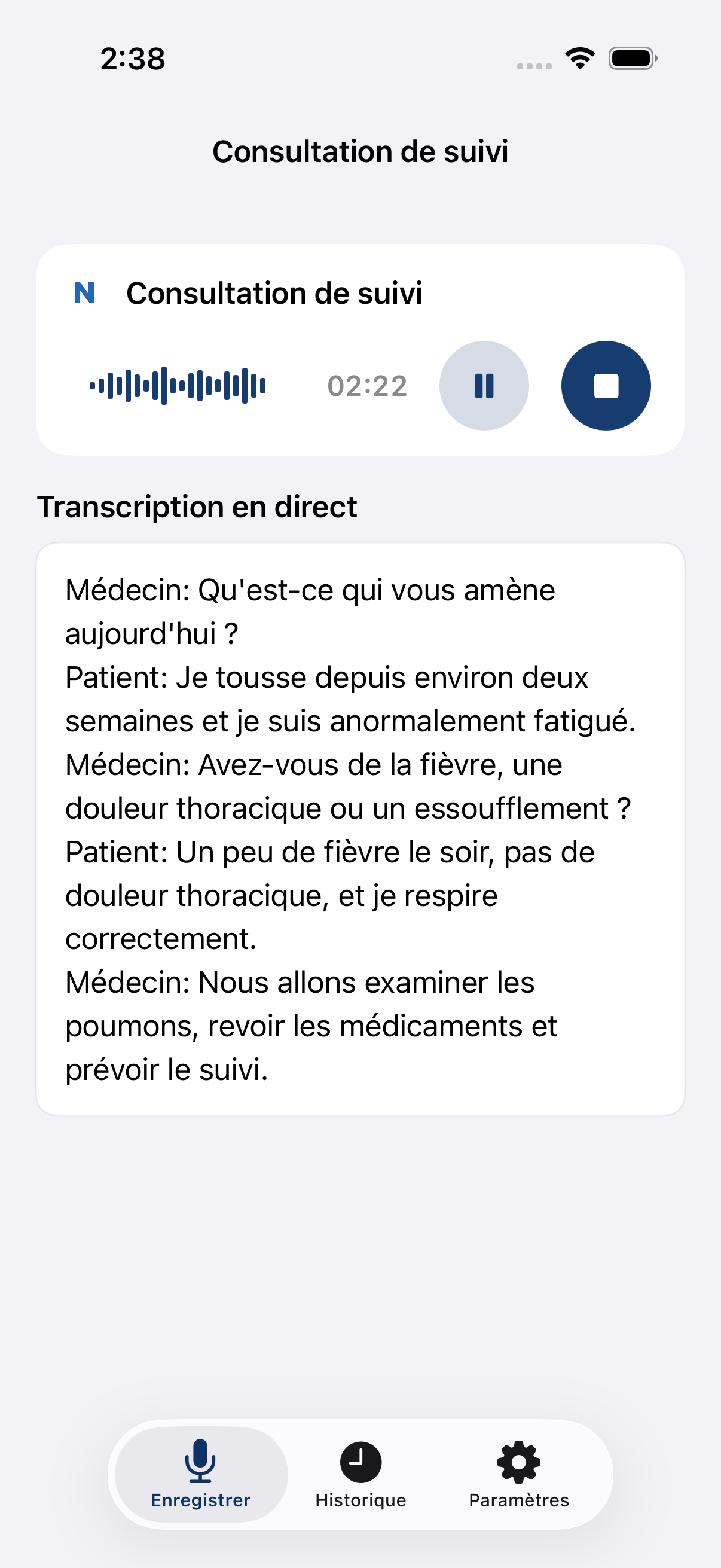
Enregistrez depuis votre téléphone ou votre ordinateur — Notat garde tous les appareils synchronisés en temps réel. Chaque note, suggestion de code et plan de suivi est généré en direct à partir de FactsContext™, les faits cliniques structurés derrière tout ce que Notat rédige.
Découvrez comment fonctionne FactsContext™Extraction en direct active.
Pourquoi les cliniciens choisissent Notat
FactsContext™ sépare la compréhension de la rédaction. Cette séparation est ce qui rend la documentation digne de confiance — et ce qui rend chaque fonctionnalité ultérieure possible.
Les faits sont à vous
Notat vous montre les faits médicaux bruts extraits de chaque consultation — pas seulement la note finalisée. Inspectez-les, vérifiez la note à leur égard ou réutilisez-les comme bon vous semble.
Chaque phrase est traçable
Parce que la documentation est générée à partir de faits structurés, chaque déclaration dans la note remonte à quelque chose qui s'est réellement passé lors de la consultation.
Rien d'inventé
L'IA directe à partir de la transcription comble les lacunes avec du texte vraisemblable. FactsContext™ est conçu pour réduire les déclarations non étayées en rédigeant uniquement à partir de faits cliniques vérifiés.
Notes you can trust
Every drafted note is tied to the evidence in the transcript. Nothing is invented, and you review before it counts.
Less after-hours charting
Clinicians on Notat spend their evenings somewhere other than the EHR. The note is mostly done when the visit ends.
Coding that is reviewable
ICD-10 suggestions come with the clinical reasoning behind them, so a clinician or coder can confirm in seconds rather than dig.
Works where you work
Drafts push into the EHR and systems your clinic already uses. Notat fits the workflow instead of forcing a new one.
Le forfait gratuit inclut 10 notes par mois.
Consultez vos faits — essayez gratuitement →Voir tous les tarifs →Quatre étapes jusqu’à la note finie
1
Start the visit
Open Notat on the web or the iOS app and begin. No templates to configure, no voice commands to memorize.
2
Have the conversation
Talk with your patient as usual. Notat transcribes and extracts the clinically relevant facts in real time.
3
Review the note
A structured draft is ready when you stop. Read it, edit it, and check the suggested codes against the evidence.
4
Send it on
Push the finished note to your EHR or export it. The visit is documented before the next one starts.
Comment les cliniciens utilisent Notat
During the visit. Notat listens in the background. Keep your attention on the patient instead of a screen, and the conversation is captured as it happens.
After the visit. A structured note is ready in seconds, organized the way your specialty expects. Edit anything, then sign off and move on.
Across the day. Stop carrying documentation home. Visits that used to mean an hour of typing now close before the next patient walks in.
Across languages. Patients speak in their own language and the note comes out in yours. Notat handles 14 languages without losing clinical detail.
Questions fréquentes
What is an AI medical scribe?
An AI medical scribe listens to the patient consultation and drafts a structured clinical note from it, so the clinician reviews a finished draft instead of typing one from scratch. Notat ties every part of the draft to the evidence in the transcript.
What is the difference between an AI scribe, dictation, and transcription?
Medical transcription turns recorded speech into text, and medical dictation turns a clinician's spoken instructions into a note. An ambient AI medical scribe listens to the consultation and drafts a structured clinical note from the visit for the clinician to review and sign.
Is the AI note ready to sign without editing?
No. The note is a draft for the clinician to review and edit. Notat never invents content, and every suggested code is checked against the documented encounter before it is used.
Does it work in my language?
Notat supports 14 languages. Patients can speak in their own language and the note is drafted in the language the clinician works in, without losing clinical detail.
Does it suggest ICD-10 codes?
Yes. Notat suggests ICD-10 codes supported by the documented facts, each with its clinical reasoning, so a clinician or coder can confirm quickly rather than search from scratch.
How much does Notat cost?
The Free plan includes 10 notes per month. Paid plans for higher volume and clinic features are listed on the pricing page.
How is patient data protected?
Notat processes and stores data in the European Economic Area under GDPR. Audio is handled in short chunks and each chunk is deleted after processing, so a full recording is never stored. Data is encrypted in transit and at rest, notes are deleted automatically after 24 hours, and clinical inputs are not used to train models. For a data processing agreement, contact [email protected].
Where is my data stored?
All processing and storage take place within the European Economic Area (EEA). Your data does not leave the EEA.
How do I get the note into my EHR?
You can copy or export the finished note into any EHR. Notat does not replace your record system; it gives you a note ready for your review to put into it. Direct EHR connections are enabled for selected accounts, so ask us on the contact page if you need one.
How accurate is the note?
Notat extracts the clinical facts from the conversation first and writes the note only from those facts. Each sentence can be traced back to what was said, and you review and edit the note before signing. As with any AI draft, your review is the final safeguard.
Ce que fait la documentation médicale par IA
La documentation médicale par IA transforme la conversation entre le médecin et le patient en brouillon de note clinique. La documentation ambiante fonctionne en arrière-plan, sans obliger le médecin à dicter ou à écrire pendant la consultation.
Transcription médicale
Transforme un enregistrement ou une dictée en texte.
Dictée médicale
Transforme les instructions vocales du médecin en note structurée.
Documentation médicale ambiante
Écoute la consultation et prépare un brouillon du compte rendu.
Comment fonctionne Notat
Les faits cliniques sont d’abord extraits. La note est ensuite rédigée à partir de ces faits et vérifiée par le médecin avant signature.
Choisir et faire confiance à un assistant médical IA
Try the visit without the paperwork
Notat drafts the note from the conversation so you can spend the visit with your patient, not your keyboard. Start a free trial in about ten minutes.